

Staff augmentation functions as a specialized workforce model, decoupling legal employment compliance from internal operational control. By integrating external specialists directly into existing delivery cycles, organizations scale technical capacity without transferring architectural accountability. Achieving sustainable ROI requires managing hidden overhead—specifically onboarding drag, turnover volatility, and knowledge decay—rather than optimizing solely for hourly rates. Success hinges on mature governance frameworks and standardized knowledge retention protocols.
-
Staff augmentation is a workforce model, not a delivery model. Execution and outcomes remain fully client-managed.
-
Adoption is high, but failure risk is significant. Nearly 60% of companies plan to use staff augmentation by 2026, yet ~50% of engagements fail or are renegotiated in year one without proper governance.
-
True cost often exceeds quoted rates. Real total cost typically runs 20–50% higher once management overhead and turnover are included.
-
Success depends on execution discipline. Fast onboarding, 80%+ retention, and clear ownership strongly correlate with successful outcomes.
What is Staff Augmentation?
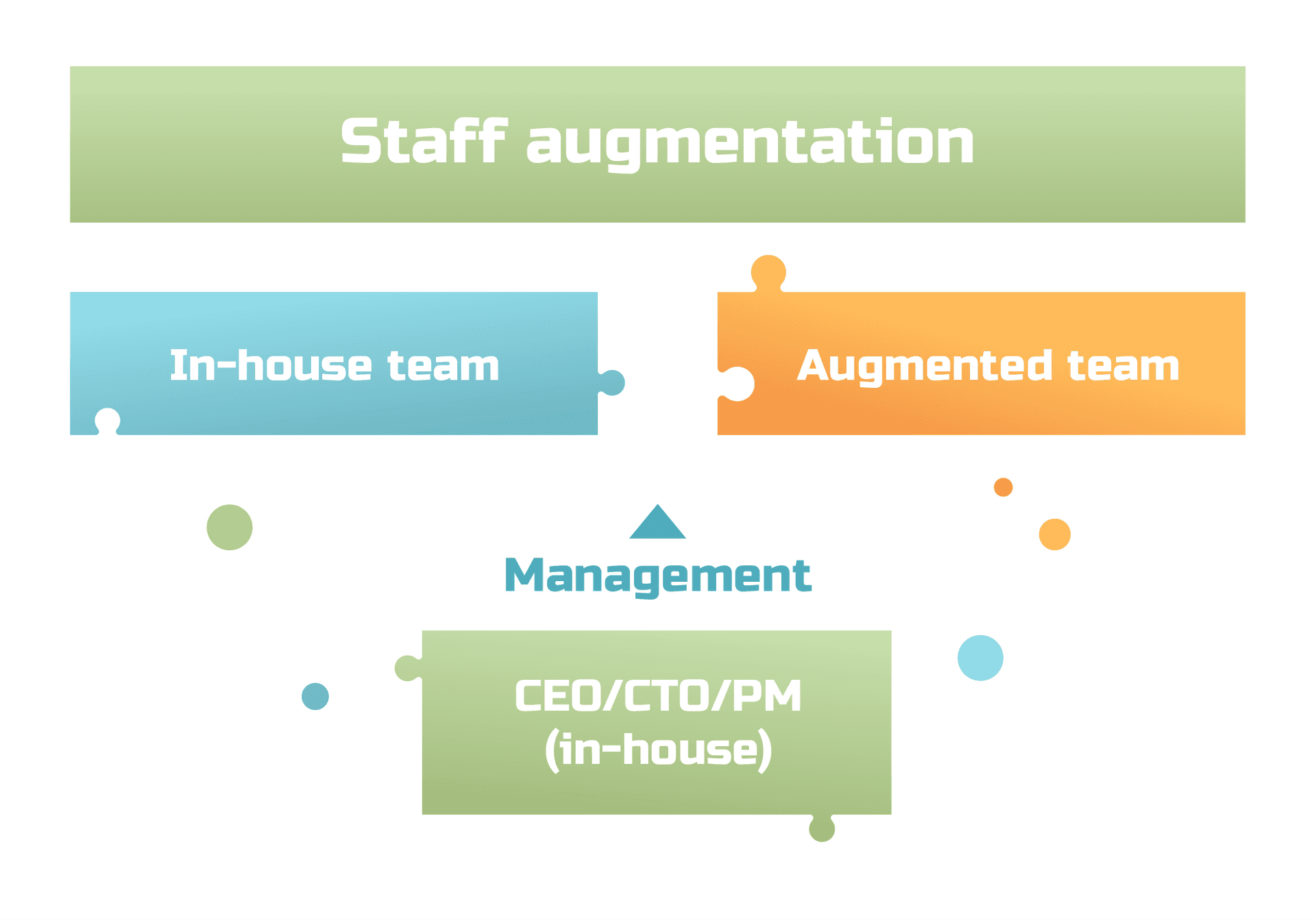
Staff augmentation is the practice of reinforcing an existing in-house team with external professionals who operate under the client’s direct management. Augmented specialists follow internal workflows, use the same tools, and contribute to the same product objectives as full-time employees.
The defining feature of this model is responsibility separation. The client controls priorities, architecture, and delivery decisions. The provider remains the legal employer and manages payroll, contracts, and labor law compliance. This distinction separates staff augmentation from outsourcing, where delivery responsibility is delegated externally.
Because the model sits between hiring and outsourcing, it is often misunderstood. Staff augmentation is not a delivery guarantee and not a substitute for leadership. Organizations without clear ownership structures consistently experience higher failure rates.
How Staff Augmentation Works in Practice
Operationally, staff augmentation mirrors internal team dynamics. External specialists are embedded into existing teams, participate in planning cycles, and communicate directly with internal stakeholders. Day-to-day execution remains fully client-managed.
Onboarding quality directly impacts productivity. Senior developers with structured onboarding typically reach high productivity within the first two weeks, while junior or highly specialized roles often require three to four weeks. Poor onboarding can double ramp-up time, leading to rework and delivery delays.
In practical terms, the client remains responsible for:
-
task prioritization and sprint planning
-
technical and architectural decisions
-
performance feedback and quality control
The provider does not supervise execution or delivery outcomes.
Staff Augmentation as a Workforce Model, Not a Delivery Model
One of the most common reasons for failure is treating staff augmentation as outsourced delivery under a different name. This misconception leads to misaligned expectations and governance gaps.
Staff augmentation shifts employment boundaries, not ownership. The client retains accountability for timelines, quality, and outcomes. Augmented specialists extend execution capacity, but they do not replace leadership or product ownership.
Organizations with structured internal processes consistently outperform those with weak leadership. Staff augmentation amplifies organizational maturity rather than compensating for its absence.
Types of staff augmentation
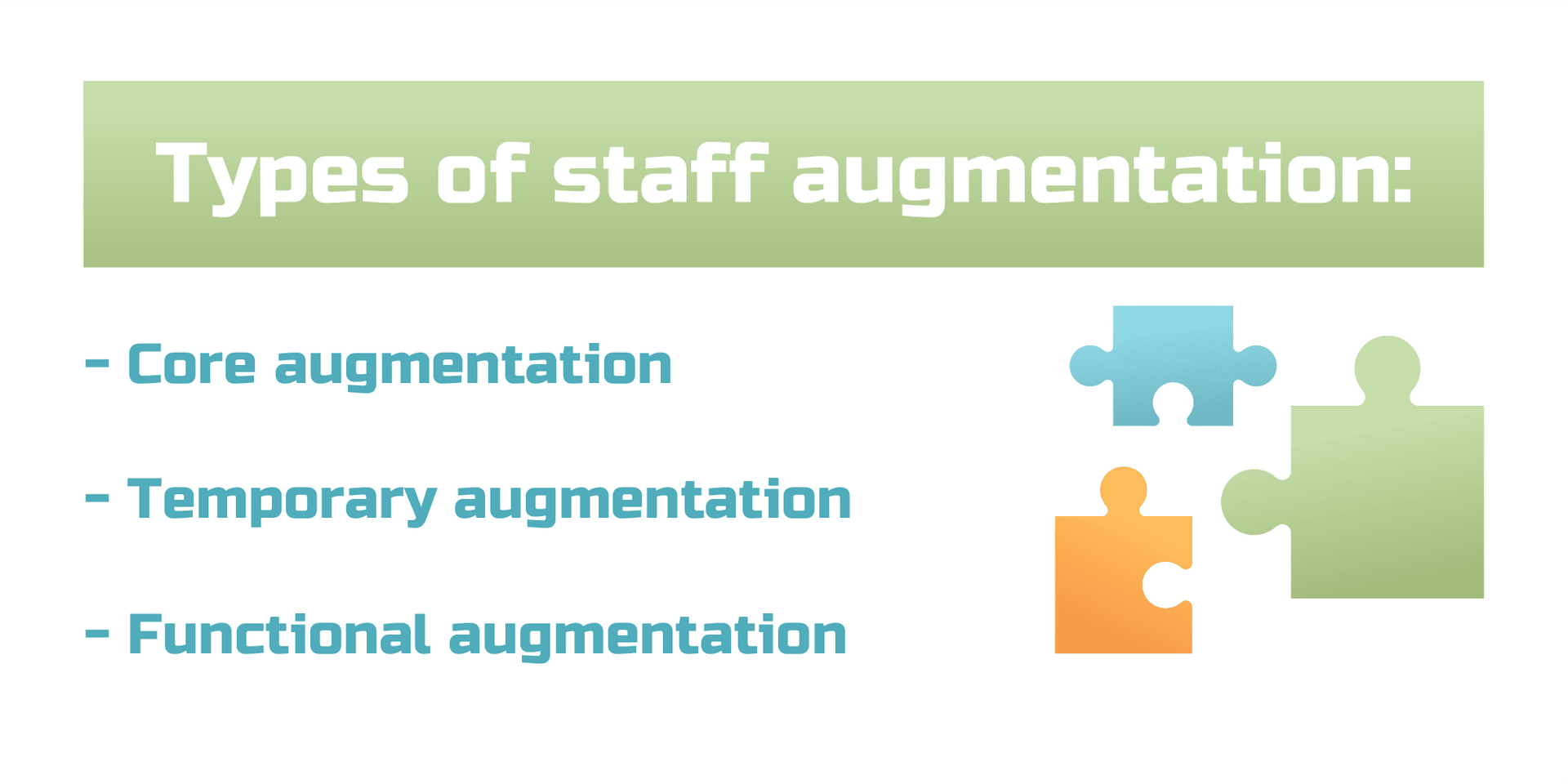
Staff augmentation is not a single uniform approach. Its effectiveness varies depending on engagement type.
Companies use augmentation to:
-
fill operational or general roles where speed matters
-
access scarce skills such as AI, cloud, cybersecurity, or blockchain
-
integrate senior experts influencing architectural decisions
These scenarios are commonly grouped into:
-
commodity-based augmentation with higher turnover risk
-
skill-based augmentation with the strongest ROI
-
highly skilled augmentation requiring strong cultural alignment
Each category has different success drivers and risk profiles.
Staff Augmentation Services and Engagement Models
Staff augmentation services refer to the structured delivery of external specialists through a provider that manages sourcing, employment, compliance, and replacement risk, while operational control remains with the client.
Unlike informal contractor hiring, staff augmentation services are designed to scale teams predictably, reduce legal exposure, and ensure continuity through standardized onboarding, documentation, and retention processes.
Staff Augmentation vs Other Workforce Models
When comparing staff augmentation with software development outsourcing models, the key difference lies in how responsibility and control are distributed.
Outsourcing models typically shift delivery ownership to a vendor, while staff augmentation keeps execution, prioritization, and quality control on the client side. Understanding this distinction is essential when selecting the right engagement model for product development.
Workforce Model Comparison
| Criterion | Staff Augmentation | Outsourcing | Managed Services |
|---|---|---|---|
| Operational control | Client-managed | Vendor-managed | Vendor-managed |
| Delivery responsibility | Client | Vendor | Vendor |
| Flexibility | High | Medium | Low |
| Cost predictability | Medium | High | High |
| Typical failure risk (Year 1) | High | Medium | Lower |
| Best use case | Scaling internal teams | Fixed-scope delivery | Ongoing operations |
Contract Structure and Legal Considerations
Contracts are central to staff augmentation because operational control and legal employment are separated.
In standard agreements, the provider remains the legal employer and handles payroll, benefits, and labor law compliance. Intellectual property clauses typically define all work as client-owned under work-for-hire provisions. Confidentiality and data protection clauses are standard, especially in regulated industries such as fintech.
Cross-border engagements add tax, data residency, and local labor regulation considerations that must be addressed upfront to avoid long-term compliance risk.
Cost Structure and True Total Cost
Quoted hourly rates rarely reflect the true cost of staff augmentation. While advertised rates often range between $35 and $75 per hour, real-world benchmarks show that true total cost frequently exceeds quotes by 20–50% due to management overhead, turnover, and rework.
This cost behavior aligns with workforce economics research published by Gartner and organizational efficiency studies by McKinsey, which emphasize management overhead and execution drag as dominant hidden cost drivers.
| Quoted Rate | Typical Hidden Costs | True Total Cost |
|---|---|---|
| $35/hr | High management overhead, rework | $85–95/hr |
| $50/hr | Moderate overhead | $65–75/hr |
| $65/hr | Low overhead, high autonomy | $70–80/hr |
Knowledge Retention and Dependency Risks
Knowledge retention is one of the most underestimated risks in staff augmentation. When external specialists rotate frequently, critical insights can leave with them.
Organizations relying only on informal knowledge transfer lose a substantial portion of accumulated know-how. Teams that implement structured documentation, ownership pairing, and early knowledge transfer significantly improve long-term capability retention and reduce dependency on individual contributors.
Success Rates and Failure Patterns
Large-scale workforce execution research shows that roughly half of staff augmentation engagements fail or require renegotiation within the first year. Failures are strongly correlated with poor onboarding, unmanaged costs, and unclear internal ownership.
Analyst consensus, including data summarized by Gartner, indicates that success rates exceed 80% when organizations meet four conditions:
-
retention above 80% at 12 months;
-
time to autonomous productivity below 21 days;
-
true total cost within 20% of quoted rate;
-
clear internal ownership and decision-making.
When Staff Augmentation Works and When It Fails
Staff augmentation performs best in organizations with established processes, clear leadership, and measurable delivery standards. It is particularly effective for fintech and blockchain projects, where compliance-aware expertise is scarce.
The model fails most often in environments with weak management, unclear objectives, or long-term ownership expectations without retention planning. Multi-year products typically require in-house teams or dedicated delivery models to maintain continuity.
Final Perspective
Staff augmentation is neither a shortcut nor a guaranteed efficiency gain. It is a workforce strategy that reallocates employment risk while increasing operational responsibility.
When applied deliberately and governed with discipline, staff augmentation enables flexibility without sacrificing control. When treated as a cost shortcut or delivery substitute, it becomes a source of hidden costs and execution risk.