

Educational app development requires a balance between rapid feature deployment and long-term structural integrity. To succeed in 2026, software architects must prioritize modular scalability and data resilience. Your team must address operational complexity and security requirements from the initial design phase.
Which architectural pattern supports educational app scalability
Microservices allow teams to scale individual components independently while monoliths offer simplicity for smaller projects. Choosing between them depends on your traffic volume and operational budget. Monolithic architectures bundle all features into one codebase, which simplifies initial development and testing. It suits early-stage startups with limited DevOps resources. As user traffic grows, horizontal scaling becomes difficult.
Microservices separate concerns into isolated units, allowing you to assign cloud resources based on demand. A generative AI module requires GPU clusters, while static content needs CDN integration. Moving to microservices increases operational complexity. Your team must manage container orchestration via Kubernetes. This requires dedicated DevOps resources for cluster maintenance.
You need distributed tracing to debug issues across service boundaries. Tools like Jaeger provide visibility into request flows. Prometheus and Grafana monitor system health in real-time. Without these tools, identifying the root cause of a failure is impossible in a distributed environment. Enterprise EdTech favors microservices to manage technical debt. Modular approaches allow engineers to update features without redeploying the entire system.
Comparing architectural solutions for 2026 learning platforms
Microservices treat each function as a standalone unit, whereas monolithic structures maintain a unified database and server logic which limits operational agility.
| Technical Attribute | Monolithic Architecture | Microservices Architecture |
| Scalability | Vertical (Larger servers) | Horizontal (Auto-scaling instances) |
| Operational Cost | Lower (Simpler DevOps) | Higher (Kubernetes management) |
| Fault Isolation | Low; one bug crashes everything | High; failures stay isolated |
How to manage the migration path from Monolith to Microservices
The Strangler Fig pattern provides a low-risk method to migrate by gradually replacing monolithic functions with microservices. This prevents total system downtime during the transition. You start by identifying resource-intensive modules. Frequently, video delivery or quiz engines become the first candidates. You build the new service alongside the existing monolith. A proxy layer routes specific traffic to the new service.
Data migration is the most sensitive part of this process. Splitting the database ensures true service isolation. You use event-driven patterns to sync data between the old and new systems during the transition. This ensures that student progress records remain stable and up to date. Your engineering team avoids the pitfalls of tight coupling. You achieve a clean separation of concerns, which facilitates future feature expansion.
Does the database schema influence student progress tracking
Relational databases like PostgreSQL ensure strict data integrity for certification and grades. NoSQL systems like AWS DynamoDB scale better for high-volume telemetry data. Student progress involves complex relationships between users and learning paths. Relational databases handle these connections using SQL. Foreign key constraints prevent orphaned records.
Tracking performance requires deep observability. You integrate Prometheus to collect metrics and use Grafana to visualize query latency. Distributed tracing via Jaeger helps see how user requests move through multiple databases. This data informs infrastructure scaling decisions. It ensures that reporting remains fast during peak exam periods. Selecting a database involves analyzing transaction volume and consistency needs.
What are the strategic development steps for 2026
Modern development follows a sequence of Architectural Discovery, AI Modeling, and Distributed Testing. This workflow prioritizes system resilience and technical accuracy. Architectural Discovery is the first step. Your team defines service boundaries and ownership. You identify which services require high availability and select the tech stack based on concurrency. Go or Node.js serve well for API gateways, while Python handles AI processing.
Testing strategy for distributed systems is a primary focus. Unit tests are insufficient for microservices. You implement integration tests across interfaces and simulate user flows using Playwright. Chaos engineering identifies how the system recovers from outages. This proactive approach identifies weaknesses before they impact users. Your software quality remains high throughout the lifecycle.
How do AI personalization and Offline-Sync impact user retention
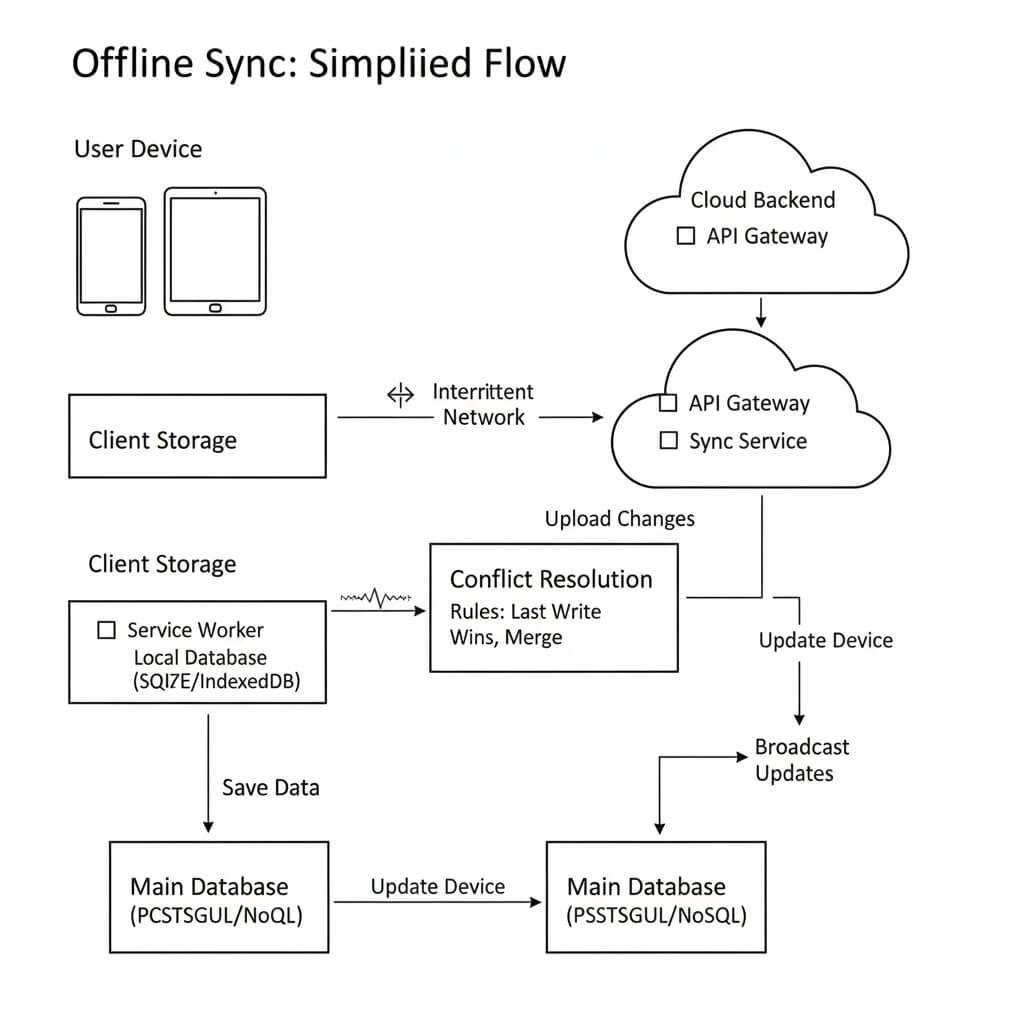
Agentic AI provides real-time tutoring while SQLite WASM enables advanced offline capabilities in 2026. Personalization is a requirement for student retention. You implement Agentic AI using RAG to ensure the AI only uses your verified curriculum. The AI analyzes performance to adjust the difficulty of lessons, keeping the learner in the optimal zone of growth. Immediate feedback on assignments significantly boosts student engagement.
In 2026, you use SQLite WASM for client-side storage. This provides a full relational database inside the browser or mobile web view. It is a powerful alternative to basic IndexedDB for complex queries. You manage local data states and sync them when the connection returns. Version vectors help resolve conflicts if the same record is updated on multiple devices. This ensures a seamless transition for learners.
What security protocols protect student data
Verifiable parental consent is an architectural requirement for COPPA compliance. JWT validation on the backend ensures only authorized requests reach your student data. You implement OAuth 2.0 for authorization, where JWTs carry user claims in a secure token. You must validate these tokens on the backend for every request. A token alone is not secure.
Compliance with COPPA requires verifiable parental consent before collecting any data from children. You must build this gate into your onboarding architecture. It is not a simple form. Your system must verify the identity of the parent using credit card validation or government ID. You store this consent as a permanent audit log. Without this, your app risks legal penalties. Security at rest is ensured through AES-256 encryption.
Infrastructure and Cost Analysis
Cloud providers like AWS and GCP offer diverse pricing models for EdTech. Infrastructure costs impact your long-term stability. Microservices increase egress costs because services communicate over the network. You use spot instances for non-critical background jobs to save money. Server-Side Rendering (SSR) improves page load speeds but incurs high CPU costs. You mitigate this by using edge deployment and heavy caching for static assets.
Real-World Case Studies: Udemy and Coursera
Udemy uses microservices to manage its vast catalog and instructor tools. This allows them to update search engines without impacting the video player. Coursera implements a strong mobile-first strategy with robust offline capabilities. They use advanced analytics to personalize recommendations. Their success validates the need for a resilient, distributed architecture. You can learn from their migration paths to avoid common scaling traps.
The choice between monoliths and microservices is not an absolute rule. Small teams developing specialized niche tools might find microservices too expensive to maintain. The overhead of Kubernetes and distributed tracing drains a small budget. In these cases, a well-structured monolith is the better choice. It allows you to focus on the educational content rather than infrastructure management. Context is the most important factor.
Beyond traditional web and mobile architectures lies the future of immersive learning. Virtual and Augmented Reality (VR/AR) present unique challenges for data latency and 3D asset delivery. You should explore how 5G and Edge Computing facilitate high-fidelity educational experiences in real-time. The integration of haptic feedback and spatial audio will transform how students interact with digital content.