

Have you imagined how the world of crypto and traditional money interacts? Here’s an answer: on-ramps and off-ramps take the lead. Without an on-ramp, a potential investor would have fewer convenient options for converting money into digital assets.
Same with off-ramps: a successful B2B trader will not be able to cash out the received revenue without the provider, who can effortlessly convert crypto into fiat. Hence, the article discusses the non-negotiable role of on/off-ramps as an indispensable part of enabling businesses entering and exiting the Web3 world.
-
Businesses have to demonstrate precision in their business needs, as it will directly affect the selection of the on-ramp solution from CEX to Widgets/API.
-
Selecting a reliable ramp provider requires a thorough analysis of licenses, tech integration, and currency coverage to prevent issues such as hidden spreads or transaction delays.
-
Businesses should consider the regulatory friction and speed issues of ramp providers and pay attention to modular KYC & Layer 2 blockchain solutions.
Why Fiat Ramps Matter in Crypto
Fiat ramps bridge the gap between digital currencies and the traditional financial system by supporting multiple payment methods, like traditional bank transfers, debit/credit cards, and modern digital wallets.
Buying or selling digital assets with fiat powers a borderless, digital economy by affecting crypto liquidity and its overall mainstream adoption. Europe experiences $2.6 trillion, and North America reaches $2.2 trillion in crypto transaction volume in 2025, as mentioned by Bitget, which proves the demand for crypto and the use of fiat in receiving it.
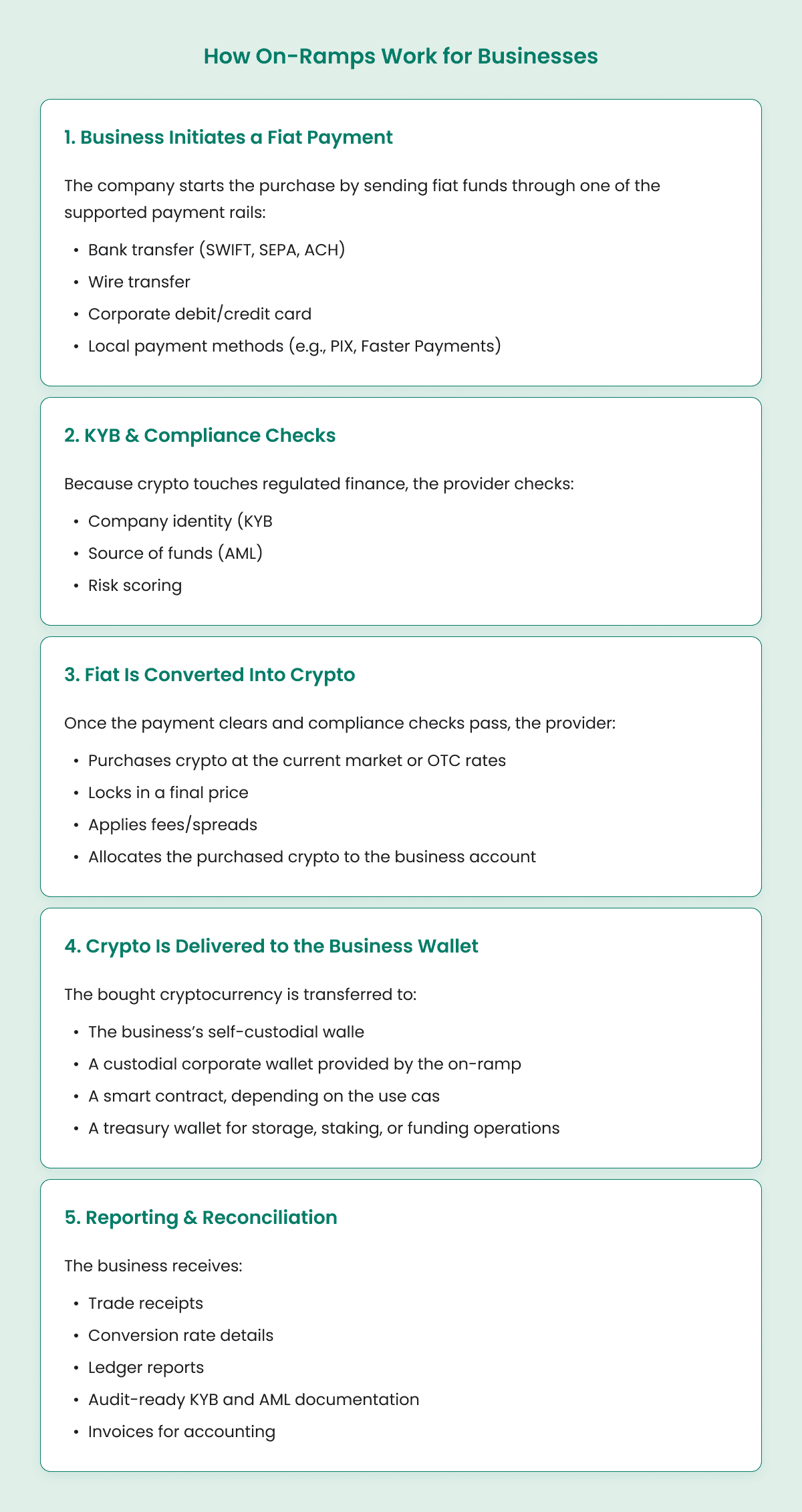
What Are Fiat On-Ramps?
Fiat on-ramps represent services or platforms that enable B2B clients to buy crypto with government-issued currencies. This conversion mechanism provides a reliable access point for entering the crypto ecosystem by making the process of digital asset acquisition fast and simple. Organizations can experience simplified access to digital asset acquisition by using fiat for purchase, investment, and trading for crypto.
What Are Fiat Off-Ramps?
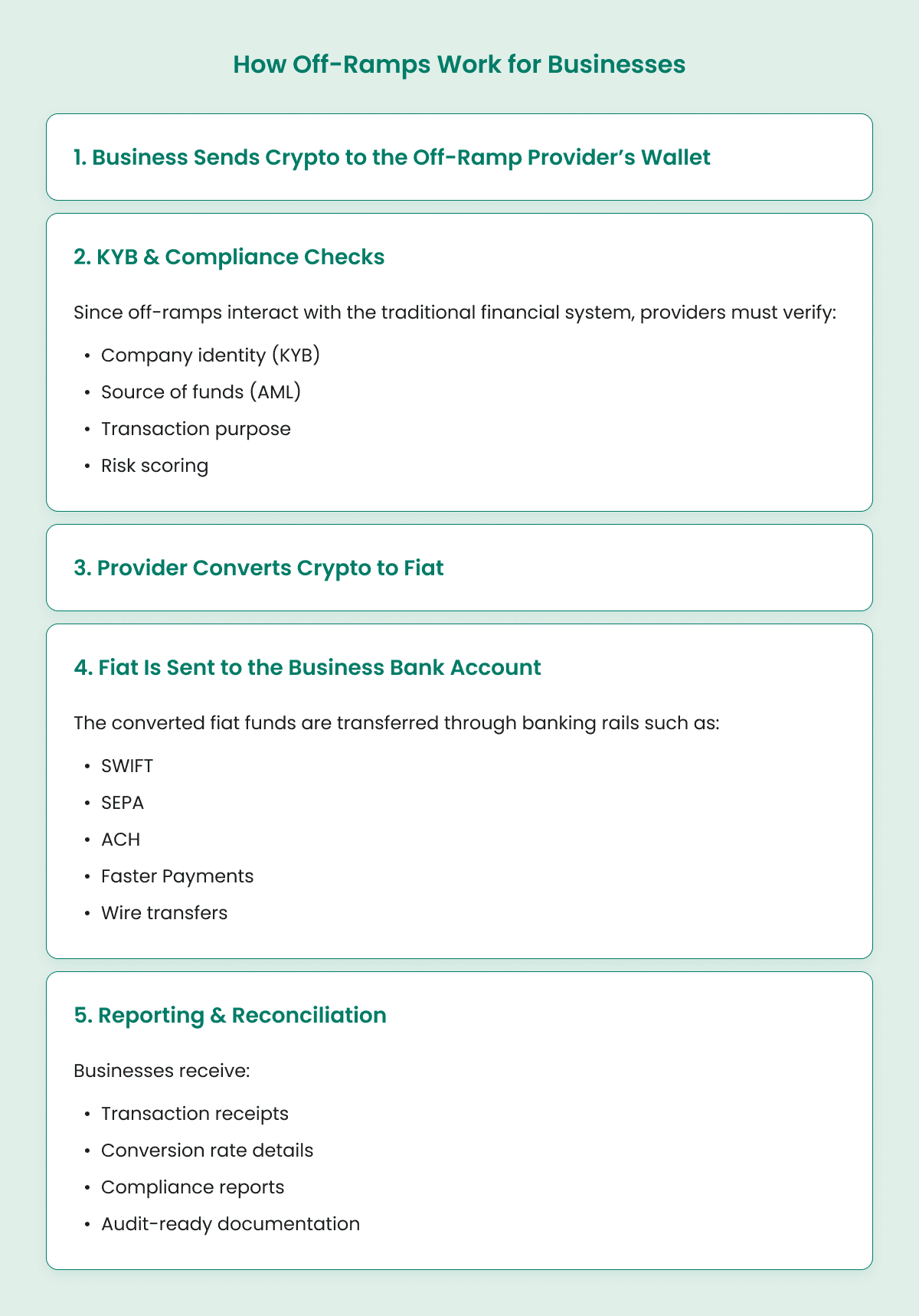
A crypto off-ramp solution represents the cash-out component of digital asset operations, enabling businesses to convert their cryptocurrency holdings into regulated, government-backed fiat currencies, like USD, EUR, etc. The resulting fiat funds are strategically directed to the business’s linked bank account or corporate debit/credit cards for use in immediate business operations and financial obligations.
On/Off-Ramp Providers: CEX & Aggregators
CEX and aggregators are critical two-way financial intermediaries in the world of digital assets. They handle the essential capital flow, acting as both on-ramp and off-ramp. Together, they ensure high liquidity, regulatory compliance, and effective transaction processing required by institutions and platforms.
CEX Exchanges: Deep Liquidity and Regulatory Compliance
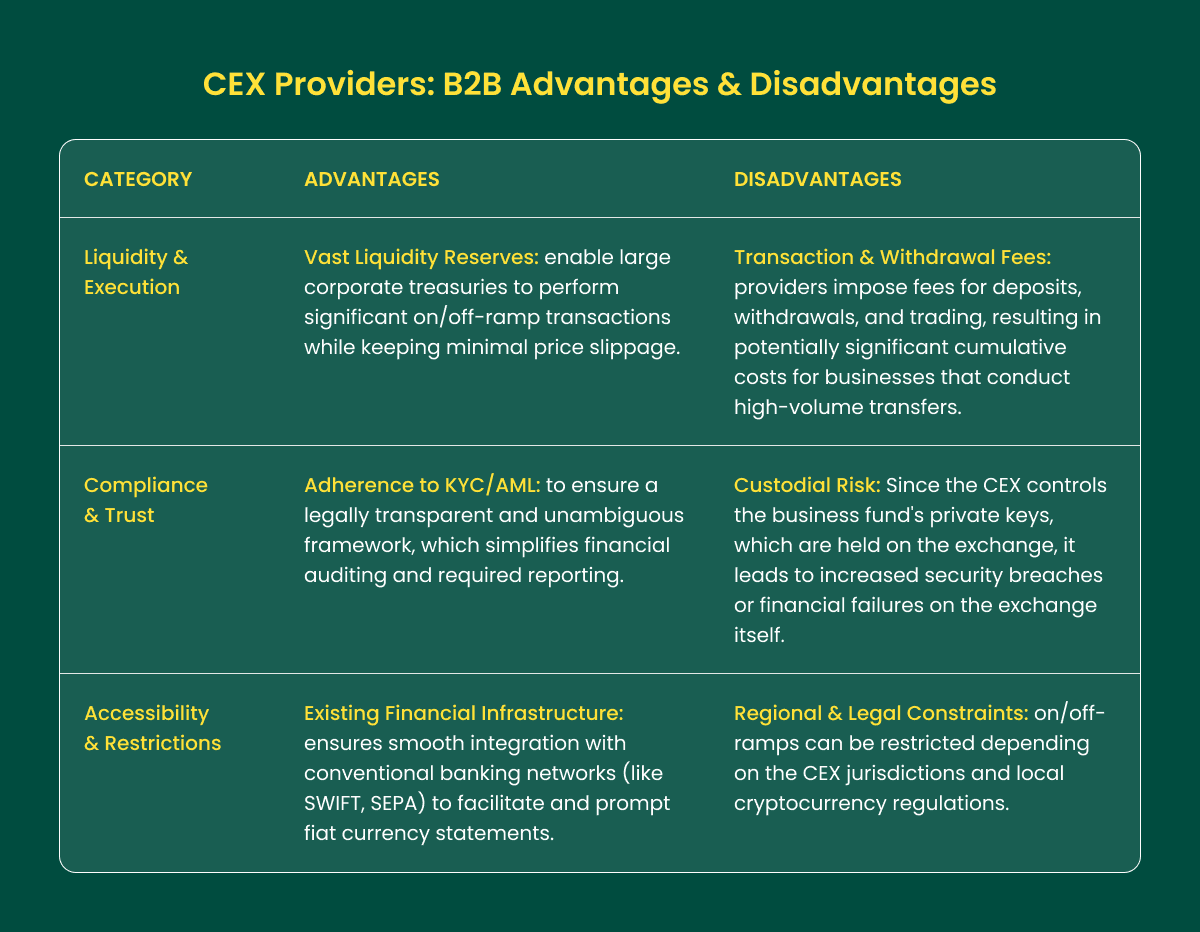
Financial institutions and large corporations are interested in CEX as their combination of vast liquidity and strong regulatory oversight makes them suitable for high-volume and safe transactions.
CEX Function & Differentiator: On-Ramp
Institutions use this for building substantial crypto holdings through direct accounts. Its key advantage for large-scale purchases is exceptional liquidity combined with strict regulatory compliance.
CEX Function & Differentiator: Off-Ramp
The main application is converting large crypto reserves back into fiat currency. Its key difference is the specialization in secure fiat settlement and regulated channels for high-volume cash withdrawals.
CEX Providers: B2B Advantages & Disadvantages
Aggregator Services: Streamlined Integration & Optimization
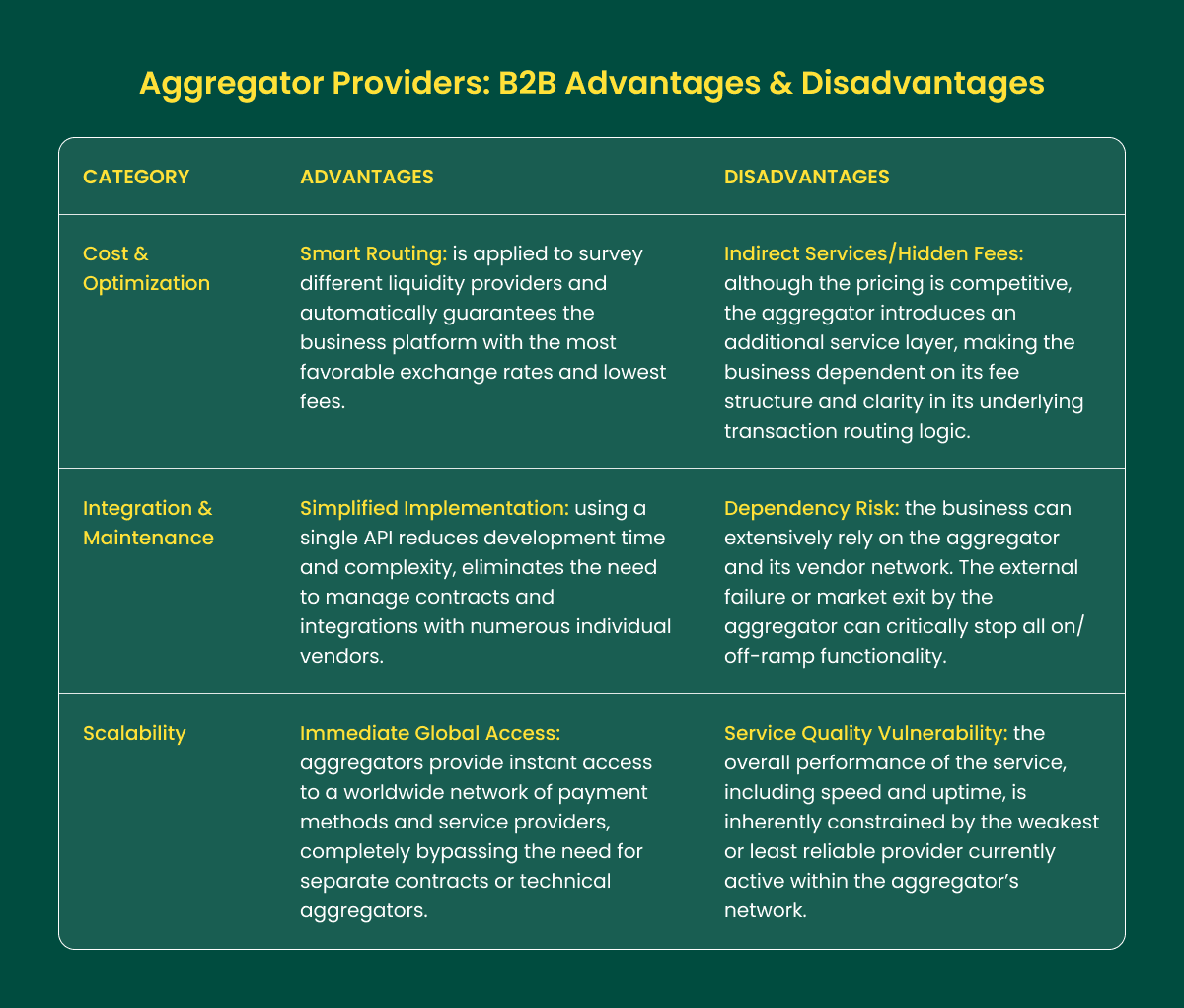
Aggregators streamline operations by providing platforms access to numerous providers through one central integration point, which primarily underlines the simplicity of the setup and optimized cost-efficiency.
Aggregator Function & Key Differentiator: On-Ramp
Platforms use an aggregator to secure the most favorable exchange rates and lowest fees for their clients from a variety of providers. This functionality requires implementing only a single API.
Aggregator Function & Key Differentiator: Off-Ramp
While high-volume crypto liquidation is often managed by CEX, some aggregators include off-ramp services via their unified API structure. This inclusion streamlines the platform’s operational workflow for converting digital assets to fiat, enhancing the overall efficiency of the business’s client experience strategy.
Aggregator Providers: B2B Advantages & Disadvantages
Business Use Cases: When and Why to Use On-Ramps
Organizations should utilize on-ramps strategically based on the volume, frequency, and regulatory needs for fiat-to-crypto transactions. When speaking about large-scale transactions, compliance, and liquidity depth, a CEX provider is the most optimal solution. If it’s frequent, small operational expenses, an aggregator will take the lead.
Funding Treasury Reserves
Businesses can apply an on-ramp when they decide to diversify their balance sheet or hedge against inflation by keeping digital assets as a store of value. This on-ramp provides a strategic benefit of asset diversification or risk mitigation, enabling companies to accumulate reserves in assets that hold value despite inflation.
CEX providers should be considered as they ensure large corporate purchases benefit from liquidity that results in minimal price slippage. They also guarantee the critical KYC/AML compliance and transparent reporting needed by institutional finance departments.
Decentralized Finance (DeFi) Investment
Businesses can seek to deploy unused corporate capital into DeFi protocols in order to earn passive income through activities like staking, lending, or liquidity provisioning. This option is critical as it optimizes capital and generates returns. This process supplies the required crypto assets for engagement in lending protocols.
A hybrid approach of CEX and aggregator is applied in the DeFi investment case. CEX is best suited for the initial, large-scale, and compliant conversion of fiat into stablecoins. Nevertheless, an aggregator (or CEX potentially) becomes preferred for the ongoing, frequent purchases of smaller, specialized tokens, granting the best rates across volatile markets.
 Take a look at the decentralized marketplaces.
Covering Operational Expenses
Businesses can use an on-ramp when they need to pay blockchain transaction fees, deploy smart contracts, or remit payroll to international contractors in cryptocurrency. The underpinning reason for using an on-ramp lies in smooth operations and expense management. The business has immediate access to the required cryptocurrency, like ETH for transaction fees or stablecoins for payments.
The presented business use case operates via the aggregator provider as it guarantees simplicity and optional pricing. The aggregator ensures the organization consistently gets the best current price for common assets while keeping straightforward integration management.
Business Use Cases: When and Why to Use Off-Ramps
Businesses should select an off-ramp based on the withdrawal volume, compliance, and geography. CEX providers will suit high-volume and high-stakes scenarios. Aggregators can be applied to streamline diverse international payments within eCommerce settlements or cross-border payrolls for medium-to-small transactions.
Liquidity Management & Cash Flow
Organizations can use off-ramps when they require immediate access to liquid fiat funds to cover short-term working capital needs or to address unforeseen financial circumstances. The business benefit provides financial agility, as off-ramp enables businesses to readily convert their crypto reserves into fiat cash flow, preventing assets from being locked in, ensuring swift responsiveness to immediate financial requirements.
The CEX provider is applicable in this case as it ensures the most reliable direct banking connections necessary for urgent, high-volume wire transfers.
Merchant Settlement & eCommerce
Off-ramps are suitable for cases when an eCommerce platform or merchant receives payments in cryptocurrency but requires that the full transaction value be immediately converted and settled in the local fiat currency.
The reason companies use off-ramps is to mitigate volatility and simplify accounting. This strategy removes the financial risk associated with crypto price fluctuations as the conversion is instantaneous. This promotes streamlined accounting since all sales are recorded directly into fiat.
Aggregator providers can be implemented in this case as they use smart routing to optimize frequent, mid-to-low volume sales. This guarantees the best available exchange rate, vital for instantly eliminating price volatility on every transaction.
Cross-Border Remittance/Payouts
Platforms like B2B payment companies or gig economy services can use off-ramps, especially when receiving revenue in stablecoins, but are required to convert those funds into the recipient’s local fiat currency before remitting the final payment to an international contractor or partner.
The reasoning behind using an off-ramp lies in reduced cost and optimized speed. An off-ramp represents a solution for cross-border transactions that are faster and less expensive than traditional banking methods, like SEPA, by leveraging crypto as an immediate conversion layer into the target fiat currency.
Aggregators are preferred for international payments because they connect with numerous local payment processors. This provider promotes localized exchange rates and overall lower fees compared to relying on a single CEX for remitting fiat to global partners.
How to Choose a Reliable Ramp Provider
Selecting a reliable ramp provider requires in-depth analysis of licenses, the number of currencies supported, compliance, speed, settlement, integrations, and APIs.
Licenses
On/off-ramps are considered regulated financial activities, subject to anti-money laundering and counter-terrorism rules. Businesses should assess whether the transmission and conversion are safe and regulation-compliant. Here’s the list of the essential legal frameworks associated with the on-ramp and off-ramp:
-
Virtual Asset Service Provider (VASP): companies that exchange crypto for fiat. This licensing framework focuses on adhering to international anti-money laundering and counter-terrorist financing rules as required by FATF.
-
Money Transmitter License (MTL) / Money Service Business (MSB): the MSB/MTL license governs the fiat-handling mechanisms and is required for services that involve fiat reception and transmission.
-
Crypto Asset Service Provider (CASP): this EU framework implies that any legal entity whose business provides services associated with the exchange of digital assets, their transmission, and payments is considered a CASP, as defined by Markets in Crypto-Assets (MiCA).
Currency Support
Currency support is a central element for on/off-ramp service provider efficiency and usability to expand global coverage and prevent double conversion.
Fiat Currency Coverage
It’s essential to pay attention to what currencies the on/off-ramp provider supports. This goes beyond the major world-accepted assets like USD or EUR, but it must include access to local currencies like CAD or AUD if the business establishes its service within these target markets.
This matters to prevent double conversion, as if the local currency is not supported, organizations will experience the hidden FX fee to obtain the supported currency. Consequently, they will need to pay the crypto-to-fiat conversion fee to receive the crypto they select, presenting the provider’s service inconvenience.
Payment Methods
Finally, on/off-ramp service providers should support versatile payment options to optimize the overall conversion rate. If businesses have limitations with making or receiving payments, a diverse range of fiat payment options can benefit all stakeholders.
KYB / AML Compliance
Compliance is the most critical aspect for on-ramp and off-ramp service providers, as any violation in regulatory compliance or audit/tax reporting can cause a business shutdown.
-
Licensing: this factor can shift the regulatory burden from the company to the service provider and protect the business from fines or bank-relevant termination.
-
KYB (Know Your Business): for B2B on/off-ramps, it’s important to select those providers who specialize in validating corporate entities by processing large-volume reporting. This aspect is central to preventing non-compliance, especially for those businesses whose transactions require due diligence and accurate tax and audit reporting.
Common Challenges in Using Fiat Ramps (And How to Avoid Them)
Both on and off-ramps have a set of challenges that businesses have to consider when trying to perform conversions by interacting with the provider. These include:
Regulatory Restrictions
The primary obstacle lies in the fact that any point connecting the decentralized crypto provider with a centralized financial institution becomes a trigger for regulatory examination, especially regarding AML and KYC requirements.
Banking Relationships
Banking institutions raise concerns over the security and legality of crypto operations. This may lead to a freeze of fiat transfers if the on-ramp partner loses its partnership with the supporting bank. A preventive recommendation for businesses is to select the providers that underline a KYB (Know Your Business) regulatory-compliant culture to minimize any transaction halts.
 Analyze the top 4 requirements to launch a fintech product in the USA.
Rigid KYC Drop-Off
An inflexible identity verification process creates a critical resistance in the client onboarding process, leading to high drop-off rates and a decline in transaction revenue. Organizations have to consider a modular KYC solution capable of dynamically tailoring verification requirements based on factors like transaction volume or risk assessment.
Transfer Delays
Transaction delays represent another challenge in off/on-ramp functionality, as instant price fluctuations slow transaction speed, provoking increased costs that negatively affect the effectiveness of critical operations like treasury transfers or instant client settlement.
Network Congestion
On-ramps can experience slowdowns in performance during periods of high intensity. This can lead to transaction failure or a stuck transaction, making the final time unpredictable. Businesses should select providers on Layer 2 and low-fee networks like Polygon or Solana to bypass mainnet congestion and minimize fees.
Custody Delays
In some off-ramps, assets move to the exchange’s cold storage prior to the fiat transaction initiation. This adds extra time to the overall withdrawal process. In this case, businesses should select a provider that enables direct wallet-to-bank transfers through secure API-driven processes, which leads to minimizing asset movement delays.
High Fees
High transaction costs, particularly those resulting from hidden or inflated exchange rate spreads, pose a significant financial risk to businesses that use on/off-ramp services.
Hidden Spreads
Providers can impose the practice of exchange rate spread inflation, representing the difference between the buy and sell prices. This leads to a critical financial risk, as the lack of transparency causes businesses to suffer loss in value and margin erosion, as the effective total cost of conversion is higher than the advertised transaction fees.
Companies have to require and constantly enforce complete fee transparency from their on/off-ramp providers. This obligates obtaining a clear disclosure of the total effective cost (TEC) that encompasses both the stated transaction fee and the applied exchange rate spread.
Summary
Crypto on/off-ramps are central elements in binding the Web3 economy and traditional payment systems. For B2B enterprises, these ramps function as a critical infrastructure, guaranteeing the necessary interoperability between decentralized digital assets and regulated fiat currencies essential for treasury management and scalable operations.
 Interested in crypto on/off-ramps for your B2B integration? Contact us, we’re ready to help.